¿Why do humans who use AI need Thomas Aquinas and Aristotle?
Redefining Teaching with Artificial Intelligence
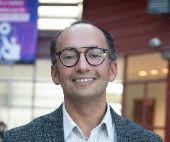
Rodolfo Marcone-Lo Presti (Viña del Mar, 1984) is a lawyer and holds a PhD in Philosophy of Law and Political Philosophy from the University of Valencia, awarded Summa Cum Laude. He has academic training in social sciences, constitutional law, and postgraduate diplomas in international studies as well as family and society studies.
He is a disciple of legal philosophers Jesús Ballesteros, Vicente Bellver, Gastón Soublette, and Howard Richards.
He has practiced law for more than ten years, including the filing of a complaint before the International Criminal Court in 2024 concerning war crimes in the Palestine–Israel conflict.
He is the author of four books and more than thirty scholarly articles and opinion columns in political, philosophical, and legal analysis.
He is a member of the Scientific Committee of the journal Persona y Derecho at the University of Navarra.
He has advised the National Congress of Chile, local governments, and human rights organizations, and has participated in global initiatives such as Scholas Chairs and the Economy of Francesco.
¿Why do humans who use AI need Thomas Aquinas and Aristotle?
We live dazzled by synthetic eloquence. The emergence of Grand Language Models (GLMs) has radically transformed our interaction with information. However, while we celebrate the capacity of these algorithmic machines to process data, we are dangerously forgetting the human capacity to process truth—a point Byung-Chul Han has been making for years.
Faced with the tide of probabilistic algorithms that give life to AI, philosophy is not a relic of the past. It is the critical operating system of the human mind, especially certain metaphysical principles born from logic. It is fundamental to start from an ontological premise: Artificial Intelligence does not know "being," only statistics. Language models are essentially mathematical; they lack what Scholasticism called intentionality. They have no intrinsic commitment to reality, to the given reality as we humans know it, but rather to the probability of the next "token." To use the analogy, these are like LLMs: mirrors that reflect their training data, inheriting biases and being susceptible to manipulation. Faced with an interlocutor who cannot distinguish essence from accident, the human user needs, now more than ever, the shields forged by Aristotelian-Thomistic logic.
The defense of reality as a primary ontology In Book IV of the Metaphysics, Aristotle establishes the most fundamental principle of all: the Principle of Non-Contradiction. The Stagirite states that "it is impossible for the same thing to be and not be in the same thing at the same time and in the same respect." This is the Achilles' heel of AI. An LLM can affirm a medical fact in one paragraph and contradict it in the next after a manipulated prompt. In critical sectors such as health and human rights, this is not a computer error, it is ethical negligence. If we delegate diagnoses or legal decisions to black boxes that violate the principle of non-contradiction, we place human dignity in the hands of chance or the manipulation of whoever controls the algorithm. Therefore, the governance of these technologies is essential, as Byung-Chul Han requested in his recent speech before the King and Queen of Spain, when delivering his acceptance speech upon receiving the 2025 Princess of Asturias International Award.
Thomas Aquinas and Truth
Centuries later, Thomas Aquinas, in the Summa Theologica, would define truth as “adaequatio rei et intellectus” (the correspondence between the thing and the understanding). We must be clear that AI does not have intellect: it has large-scale data processing. This may seem intelligent, but something is missing: it cannot “correspond” to reality because it does not understand it. It has no moral feelings, nor a sense of the duration of time, which Bergson identifies as the root of the evil of mechanization. AI only mathematically simulates reality. Faced with the ambiguity of bots, which often avoid firm answers through relativism, we must uphold the Principle of the Excluded Middle: a proposition is either true or false; there is no middle ground. Reality does not admit gray areas when it comes to factual truth; this is the essence of logic and metaphysics, along with the other principles explained.
Conclusion
As a society, we need a renaissance of logic. It is more necessary than ever. We are at a civilizational crossroads. Academia must urgently rethink its curricula. It is useless to train brilliant technicians if we do not train thinkers capable of auditing the logic underlying the code. It is urgent to reread Aristotle and Thomas Aquinas, not out of medieval nostalgia, but out of the necessity of keeping our minds and hearts attuned to reality.
Technology will advance, but the principles of sound reasoning are immutable because they adhere to a logic that endures within a given ontology—in other words, they are real. If we fail to educate future professionals with the rigor of classical logic and metaphysics, we risk creating a society that accepts computational falsehoods as revealed truth. We would return to the machine as a god in a new, synthetic, and inhuman religion, as Simone Weil once denounced in the face of machine dominance.
For Artificial Intelligence to be a tool for progress and not confusion, human beings must recover their intellectual sovereignty, from reason and heart; that is why the famous 20th-century Spanish metaphysical philosopher Zubiri coined the concept of "sentient intelligence".
We cannot forget that the algorithm calculates, but only man understands in the full sense of logic, since his being is anchored in existential reality, where heart and mind interact with all of reality to adapt human life.
Here are some questions to help you evaluate the work of AI:
- Non-Contradiction Test: Does the AI contradict itself in the same answer?
- Essence Test (Definition): Does it clearly define what the thing is or does it go around in circles?
- Excluded Middle Test: When faced with a Yes/No question, do you resort to ambiguity to avoid making a mistake?
- Bias Detection: Does it omit classical tradition in favor of recent ideological trends?

Carver University es miembro del Global Academic Network, una red académica internacional, con presencia en Chile, Estados Unidos, España, Perú, Portugal, Andorra y Paraguay, que cuenta con más de 75 mil estudiantes de 15 nacionalidades distintas.

 .
.